







Deconditioning Syndrome: Why Every Day in Bed Matters
Preventing deconditioning syndrome (also referred to as deconditioning) relies on early movement, rehabilitation and mobilisation. Hospital-acquired deconditioning (HAD) can have a dramatic impact on patients, especially those who are older and frail.
In this post – Part 2 in our Preventing Hospital-Acquired Deconditioning Series – we look in more detail at the consequences of HAD on different body systems and how quickly deterioration can happen. We also examine three of the more serious consequences (falls, delirium and hospital-acquired infections).
For patients with limited baseline physical capacity, an acute illness or surgical intervention can quickly trigger a cycle of inactivity and decline. Reduced mobility, disrupted sleep and poor nutritional intake often occur together, amplifying the effects of deconditioning. As days in bed accumulate, muscle strength, endurance and physical ability can deteriorate rapidly, making recovery increasingly challenging.
How fast does HAD occur?
Deconditioning can disrupt every organ system, starting within hours of hospital admission. By day 7, deterioration is more widespread and profound:1,2,3
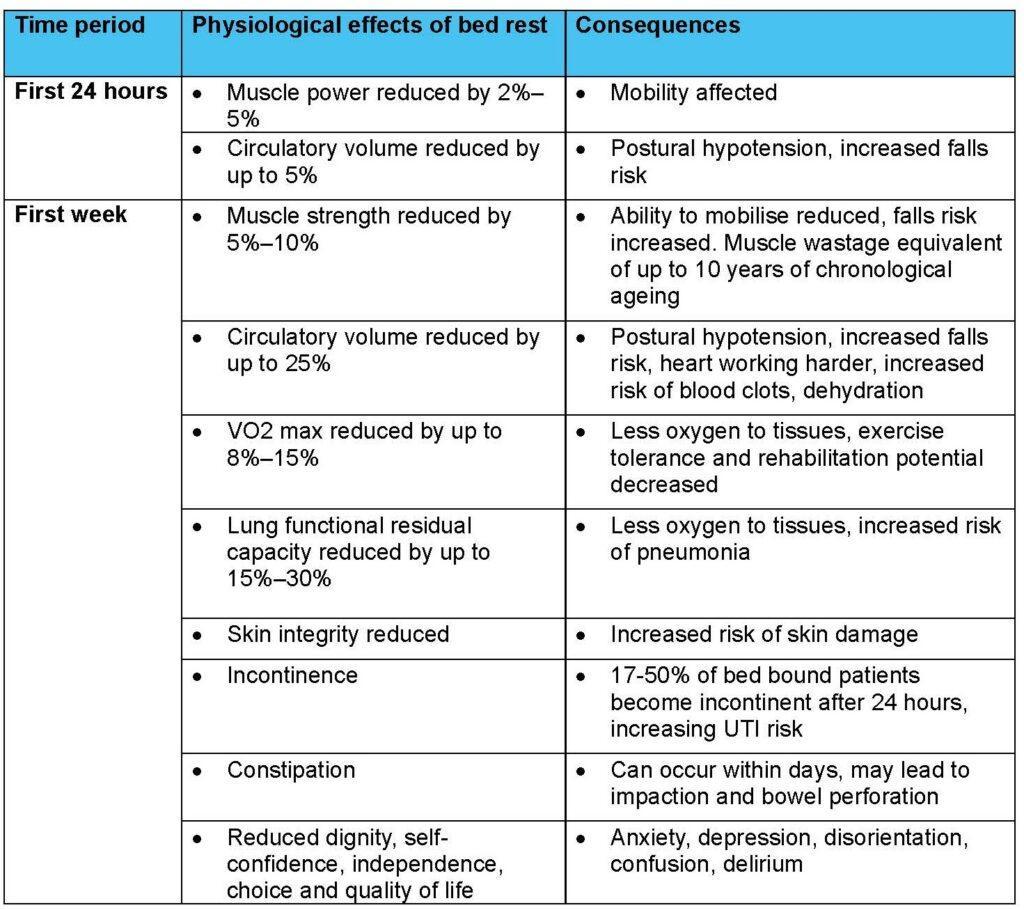
Deconditioning syndrome risks and consequences
Below, we look at three frequent consequences of HAD: falls, delirium and healthcare-associated infections.
Falls
Preventing inpatient falls is a major patient safety priority, but it is not always straightforward. Caregivers must carefully balance risks of falls against risks of inactivity.
Restricting mobility may reduce the likelihood of falls in the short-term, but it can also accelerate muscle wasting, loss of independence and deconditioning syndrome. This will increase falls risks when mobilisation resumes.
On the other hand, encouraging patients to stay active and mobilise early supports recovery and helps maintain function. Although it may initially carry a greater risk of falls, longer term it can lead to better outcomes.
The challenge lies in finding the right balance between minimising risk and promoting recovery.
Delirium
Delirium is a sudden change in a person’s mental state. Symptoms vary from person to person but commonly include:4
- Confusion and disorientation
- Unable to speak or think clearly
- Becoming either more sleepy and less responsive and/or more agitated and restless
- Changes in sleeping patterns
- Sudden suspicion or loss of trust
- Hallucinations
It can last any time from a few days to weeks or even months, and unfortunately some people never regain the baseline cognitive function they had previously.
Delirium is caused by brain function changes, which can be triggered by a number of factors, including:
- Infection
- Dehydration
- Constipation
- Sudden withdrawal of prescription medicine
People who are especially at risk of delirium include those who are frail, over 65, have dementia and have hearing or sight loss. When these risk factors are compared with the consequences of deconditioning in the table above, it is clear that prolonged bed rest can play a key part in development of delirium.
Delirium is not only frightening and distressing for patients and their families, but it is also associated with serious long-term health consequences. Research has shown that patients who develop delirium are more likely to experience poorer outcomes, including:2
- Nearly three times the risk of early mortality
- Hospital stays that are twice as long
- Twice the risk of falling
These significant impacts highlight the importance of identifying patients at risk and implementing effective measures to prevent delirium wherever possible.
Healthcare-associated infections
 Thickening and pooling of lung secretions, combined with deconditioning of the respiratory muscles, can lead to development of hospital-acquired pneumonia. Evidence has shown an in-hospital mortality rate of 24.3%,5 and an average increased length of stay of 16.3 days.6
Developing urinary incontinence during a hospital stay can also have significant consequences. A retrospective cohort study found that patients who became pad users during hospitalisation were around four times more likely to develop a urinary tract infection (UTI).7
Consequences of immobility video
Dalia Barghouthy is an Advanced Clinical Practitioner Physiotherapist, working in Critical Care. She recently delivered an excellent presentation at a Medstrom Webinar on consequences of immobility, which reiterates and expands on a lot of the information in this blog post. Watch below:
Conclusion
Although deconditioning syndrome is associated with a wide range of serious health consequences, it should not be viewed as an unavoidable part of hospital care. When the right preventative measures, therapeutic interventions, and supportive equipment are in place, many of its debilitating effects can be avoided, reduced, or reversed.
By prioritising mobility, engagement, and functional recovery from the earliest opportunity, healthcare providers can help patients maintain their independence and improve both short- and long-term outcomes. In the next part of this series, we will look at the practical solutions that are helping to make this possible.
Part 1 in this series discusses the causes, risk factors, and physical, cognitive and psychological effects of deconditoning.
Part 3 discusses how it can be reduced or prevented.
References
-
Arora S, Dolan P. Avoiding Deconditioning. In: Frailty and Sarcopenia: An Evidence-Based Guide. NHS Education for Scotland; 2021.
-
Arun B, Lewis SHM. Frailty and deconditioning on the acute take. Clin Med (Lond). 2026;26(2):100548. doi:10.1016/j.clinme.2025.100548
-
Laidler D. Physiological results relating to inactivity (2021). NHS Education for Scotland. Available online:Physiological results relating to inactivity | Turas | Learn (nhs.scot)
-
NHS Inform. 2026. Delirium | NHS inform
-
Wootton D et al. The incidence risk of hospital acquired pneumonia and associated mortality in England between 2018 and 2023. 2023. University of Liverpool. Available
-
Stewart S et al. Impact of healthcare-associated infection on length of stay. 2021. J Hosp Inf, 114 23-31.
-
Larsen EB, Fahnøe CL, Jensen PE, Gregersen M. Absorbent incontinence pad use and the association with urinary tract infection and frailty: a retrospective cohort study. Int J Nurs Stud Adv. 2023:5. doi: 10.1016/j.ijnsa.2023.100131.
Authors
Emma Tarpey – National Clinical Specialist & Liz Allan – Clinical Research Manager