






Infection Control Challenges in Corridor Care
This post looks at infection control challenges in corridor care, and ways in which these can be mitigated.
Corridor care is a term used to describe caring for patients in corridors and other temporary spaces. This starts when A&E departments become overwhelmed, with the rest of the hospital affected when patients have to be moved from A&E into already full wards.
Infection Control Challenges in Corridor Care
One of the main patient safety risks of corridor care is infection control. There are a number of reasons for this:1.2
- Lack of hand washing and waste disposal facilities
- High footfall
- Patients in close proximity to one another
- Difficulty in providing basic care – e.g. patient hygiene
When patients are in close proximity, there is a risk of those with existing infections transmitting the infection to other patients, especially to those who are frail and immunocompromised. Highly transmissible diseases such as respiratory viruses and gastrointestinal infections (e.g. Norovirus) have the potential to spread very quickly in this situation.
Patient Hygiene
In addition to close proximity, another problem which heightens infection control risks is the inability to provide adequate patient hygiene in corridors. The lack of space and warm water, unsuitable or unavailable equipment, staff shortages and lack of privacy can make care delivery extremely difficult.
An anonymous nurse described her experience with one patient:3
“One other example relating to this lack of dignity happened when a patient’s catheter overflowed because it had not been emptied. He was on a narrow trolley with a thin mattress and had become very wet. I simply couldn’t offer him the personal care he needed. There was not enough space, no privacy and no easily accessible hot water. Once I was able to gain support from staff to help me change the patient he had been laying in wet clothes and sheets for the whole morning – four hours. This is basic nursing care that I was not able to perform.”
.
An overflowing catheter often occurs because the bladder is full. There are a number of reasons why this can happen including a full drainage bag, and blocked or kinked tubing. Urine stagnating in the bladder like this increases the risk of urinary tract infection, and a wet bed/stretcher poses other significant risks, including:
- Skin damage due to constant contact with moisture
- A lowering of body temperature, particularly in frail and elderly patients
- Lack of dignity and psychological distress for the patient
Is There a Solution?
Unfortunately, corridor care is not ‘going away’ and staff must find solutions to try to mitigate the risks and provide the best patient care they can in these extremely difficult circumstances. Having suitable equipment available can help reduce some of the infection control challenges in corridor care, by providing a surface that is easier to perform care on, and a means of washing the patient safely and effectively.
Vela XL Stretcher and ECO Portable Patient Shower Combination
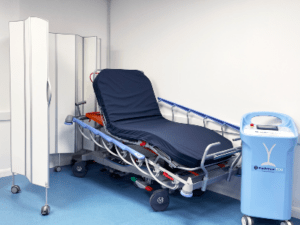
Vela XL is an extra-wide stretcher with a maximum patient weight of 270kg. Suitable for use by almost all patients, regardless of morphology, its wide platform allows easier, safer repositioning and turning. This makes hands-on care, including patient hygiene, easier. It’s also safer for staff, giving more room to deliver care and reducing manual handling risks.
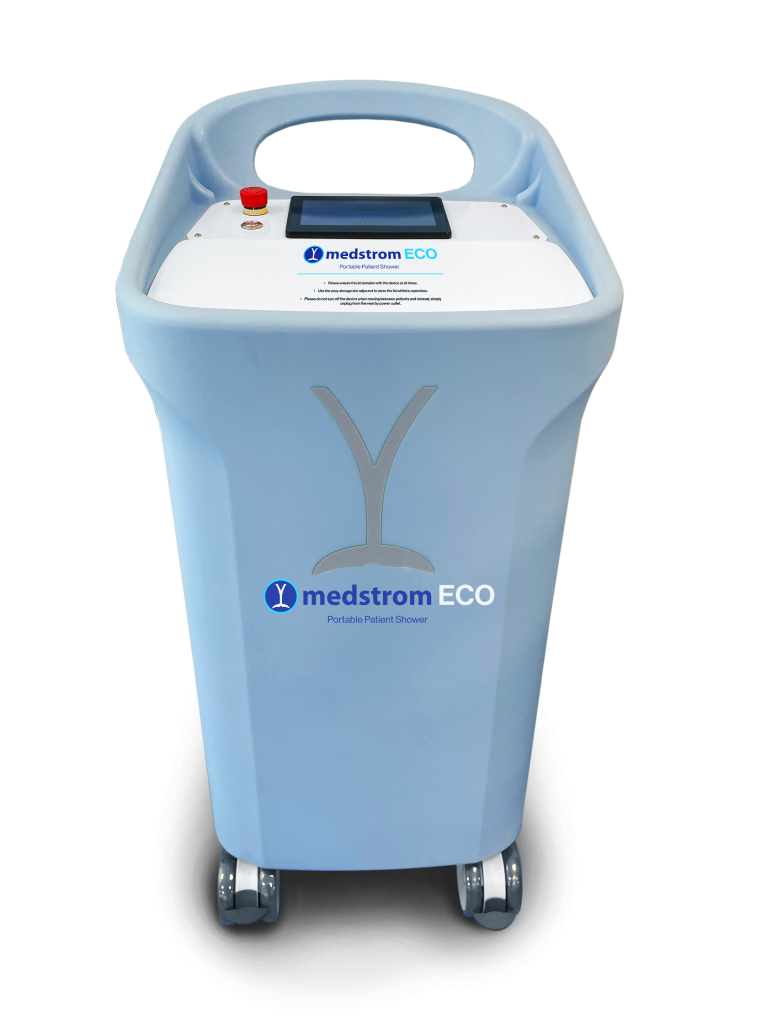
The ECO portable patient shower can deliver effective patient hygiene in corridors and other non-clinical spaces. Using a precision spray which delivers warm water at a constant temperature, it provides a faster, easier and more dignified wash for the patient than a traditional bed bath. It has proven especially useful in A&E for patients who are in corridors:
Both the Vela XL stretcher and ECO patient shower are highly mobile. So if there are patients with suspected or proven infections – or immunocompromised – they can be rapidly moved to a less busy area to reduce infection control risks. But wherever they are located, they can still benefit from the wider stretcher and a warm, refreshing wash.
Both products are available to rent, with fast delivery once ordered and 24/7/365 support from Medstrom’s Technicians and Clinical Advisors. Please contact us for more information.
References
-
Corridor care: are the health and safety risks being addressed? 2025. Patient Safety Learning Hub. Available online.
-
Patient care in temporary care environments. 2026. Health Services Safety Investigations Body. Available online.
-
A silent safety scandal: A nurse’s first-hand account of a corridor nursing shift. 2024. Patient Safety Learning Hub. Available online.
